Judge AI Software by Day 90, Not Day 1. Anyone can build a demo that works on Tuesday. The real question is what it does on a Friday night, three months later.
The Day-90 Test is the methodology Vectorz Technologies uses to decide whether an AI-powered system is ready for real users, real traffic, and real human mistakes.
We stopped treating "it works in the demo" as the finish line and started treating it as the starting gun. Real engineering begins after the applause stops.
1. The Gap Between Day 1 and Day 90
Every AI project has a Day 1. The demo goes smoothly, someone says "wow" in a executive meeting, and a pristine screenshot ends up in an investor slide deck.
Day 90 is entirely different. By then, the stakeholders who clapped have moved on to other priorities, and the software has to survive in the wild without a prompter standing beside it.
What happens in the 89 days in between:
- Unpredictable Human Inputs: Real users type prompts, queries, and boundary-pushing edge cases nobody foresaw during sprint planning.
- Silent Model Drift: Upstream model providers deploy quiet quantization updates, safety filter changes, or subtle parameter tweaks that alter output formatting.
- Evolving Habits & Data: Customer data schemas shift, terminology expands, and enterprise catalogs drift away from the initial indexing assumptions.
- Compounding Latent Errors: Unhandled exceptions, cache misses, and silent hallucinations pile up unnoticed until a client escalation lands on executive desks.
Day 90 is the day software finds out whether it was truly engineered, or merely assembled from generic templates.
2. Why a Demo Is a Poor Witness
A software demo is an experiment where the person running it already knows all the answers. The sample inputs are courteous, the Wi-Fi connection is pristine, and nobody is actively attempting to break the happy path.
Production reality looks completely different:
- A customer pastes a 40-page unstructured PDF into a chat field built for single-sentence questions.
- A global enterprise user submits a query written in a chaotic mix of two regional dialects.
- An upstream LLM provider API slows down to a crawl at the exact hour your web traffic spikes 400%.
None of this behavior is exotic or malicious. It is ordinary production usage—the exact reality that demos are carefully choreographed to avoid.
3. What the Day-90 Test Actually Is
Before we sign off on any AI-powered system as production-ready, we run it through five strict architectural checkpoints.
This is not an abstract checklist of tools or libraries. It is a systematic verification of whether your intelligence pipeline can survive unassisted in the real world:
Question 1: Can It Explain Itself?
When the system generates an answer or triggers an autonomous database mutation, can an on-call engineer trace precisely which data chunks, retrieved context, system prompt, and model version produced it?
Deterministic traceability allows you to:
- Debug an erroneous or off-target response in minutes rather than days.
- Demonstrate to enterprise clients exactly how an automated recommendation was derived.
- Defend automated actions during SOC 2, HIPAA, or financial compliance audits.
If the honest engineering answer is "not really—it just came out of the model," you do not have software in production. You have an unaccountable black box.
Question 2: What Happens When It Is Wrong?
Probabilistic models will inevitably be wrong on a non-zero percentage of queries. The defining question is what the product does next.
High-reliability systems choose one of these three recovery branches on purpose:
- Deterministic Fallback: Revert to hardcoded rules, curated domain answers, or cached canonical responses.
- Clarification Dialogue: Proactively identify ambiguity and prompt the user with bounded clarifying choices.
- Graceful Escalation: Package the full session context and hand off cleanly to a human support agent or operator.
Brittle systems choose a disastrous fourth option by accident: confidently inventing a plausible-sounding falsehood. Guardrails and validation envelopes are core architectural components, never an afterthought patched on later.
Question 3: How Will We Know It Drifted?
Models change, underlying documents change, and user phrasing drifts. Without an automated evaluation benchmark suite executing against your system on every CI/CD release, output quality erodes quietly.
In architectures lacking automated evaluation:
- The customer or client is always the first party to discover that answers have degraded.
- Nobody on the engineering team can pinpoint which release or upstream change introduced the failure.
- Attempted fixes are blind prompt tweaks that silently break three other edge cases.
At Vectorz, we mandate that regressions appear on an automated Grafana telemetry dashboard—never in a panicked customer ticket.
Question 4: What Does the Next 10x Cost?
Cost in production is not measured purely in dollars on an OpenAI invoice. P99 latency, provider rate limits, Redis queue depths, and token throughput all scale at vastly different velocities.
Common architectural traps:
- Response latency balloons from 800ms to 6,500ms as concurrent users saturate synchronous inference workers.
- Upstream tier rate-limits drop transactions without backpressure handling during daily traffic peaks.
- The token cost per request outruns the marginal revenue earned per active session.
An AI feature that feels instantaneous when tested by five internal employees can grind to a complete halt when ten thousand active users arrive simultaneously.
Question 5: Who Can Change It Safely?
Software outlives the sprint team that initially prototyped it. When new engineers join six months later, they must be able to modify features, tune prompts, and refactor pipelines without holding their breath.
That level of engineering durability demands:
- Clear, typed architecture and state machine definitions.
- Comprehensive written documentation of context flows and failure modes.
- Automated unit, integration, and red-team evaluation test suites.
- Deterministic CI/CD delivery pipelines with instant rollback capabilities.
If only one person inside the organization understands how the prompt loops and embeddings hang together, that individual is not a hero—they are your company's greatest operational vulnerability.
4. How the Test Shapes Our Engineering Process
The Day-90 Test is not an aspirational slogan on an office wall. It directly determines what our architects write, code, and deploy across each lifecycle milestone:
- Days 1 to 2: Before writing a single line of application code, we author an architecture blueprint mapping data provenance, token boundaries, and known failure vectors.
- During Development: Rigorous evaluation test suites and deterministic guardrails are developed in lockstep with feature logic—not bolted on after launch.
- At Deployment: Automated CI/CD pipelines, distributed tracing (via OpenTelemetry / Langfuse), and real-time incident alert thresholds go live simultaneously.
- At Handover: Architectural documentation, typed schema contracts, and runbooks are authored with the assumption that a total stranger will be on-call next quarter.
That way, Day 90 is an observable operational state you monitor with confidence—never a roll of the dice.
5. A Ten-Minute Version You Can Run This Week
Take any AI initiative or feature your engineering team currently ships, or plans to launch next quarter, and conduct this straightforward exercise:
- Write the five questions on a team whiteboard or shared digital canvas.
- Honestly mark each question: Clear, Partial, or Unknown.
- Count the total number of Unknowns.
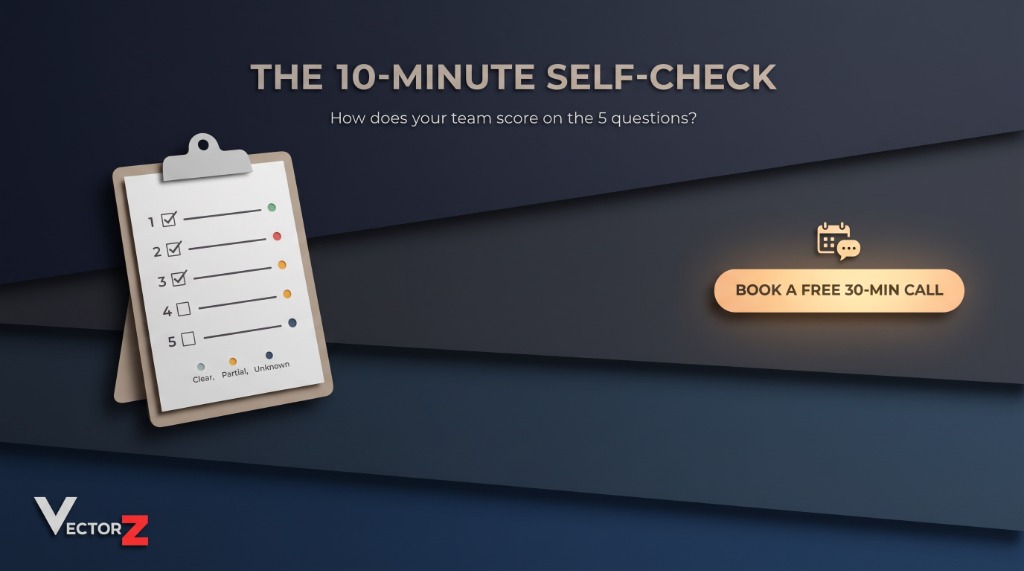
One Unknown is a manageable risk worth tracking on your sprint backlog.
Two or more Unknowns means your demo is dangerously ahead of your production architecture. It is vastly cheaper to confront those gaps today than in front of an enterprise client or auditor.
6. What Comes Next
At Vectorz Technologies, we publish the real engineering behind production software: advanced retrieval, autonomous agent architectures, AI red-teaming, and zero-downtime cloud infrastructure—written for engineers and leaders who build and procure mission-critical software.
Unsure About Your AI System's Day-90 Survival?
If your prototype shines in boardroom demos but you want to stress-test its resilience against real-world enterprise traffic, book a confidential 30-minute discovery consultation with our principal architects.