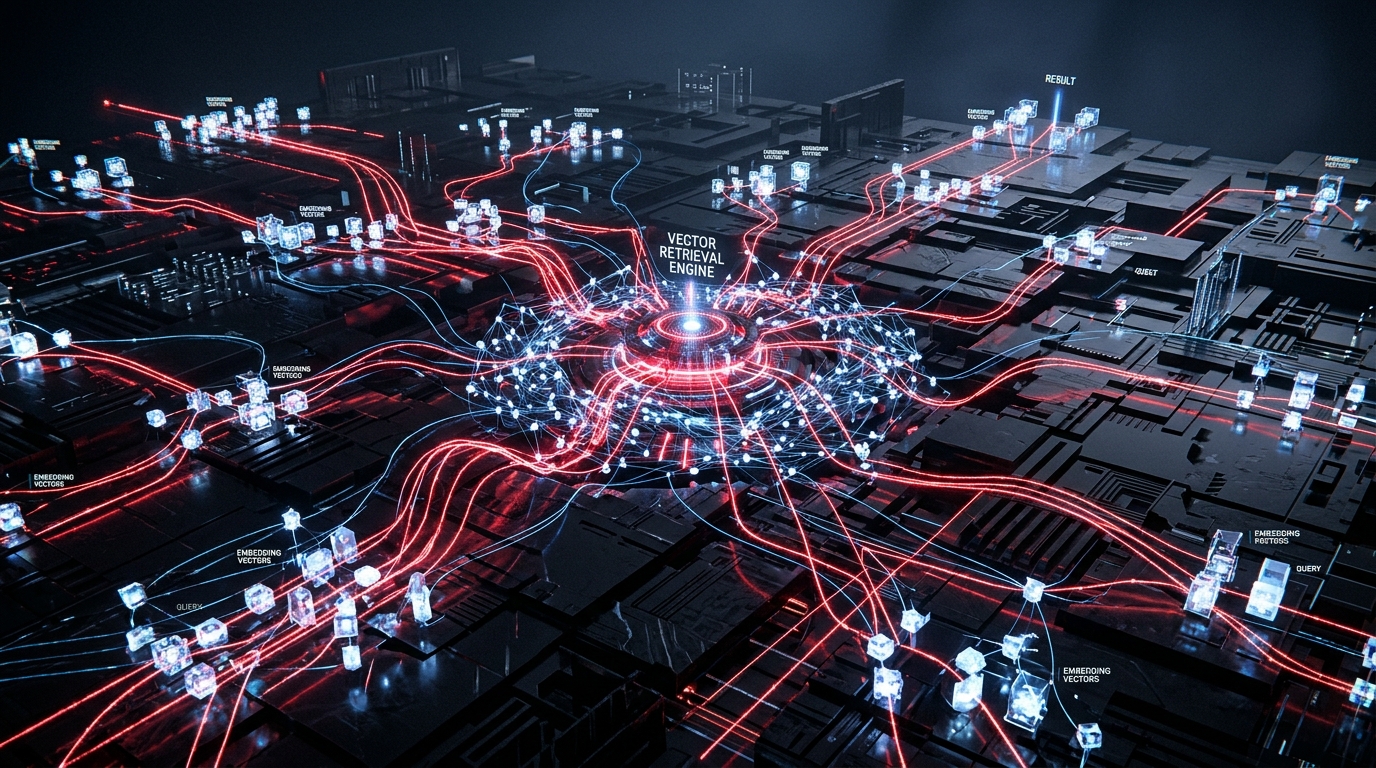
Over the past eighteen months, dozens of engineering teams shipped initial Retrieval-Augmented Generation (RAG) prototypes into production using standard recipe books: chunk Markdown files into 500-token chunks, compute dense embeddings with an off-the-shelf embedding model, store them in a vector database, and perform cosine similarity search.
In a demo environment with fifty test documents, this setup works effortlessly. However, the moment your collection expands past 200,000 complex domain documents—financial audit ledgers, compliance policies, Jira logs, or specialized ERP manuals—retrieval accuracy craters. Precision drops from 88% down to the mid-40s, and developers are left wondering why their LLM is hallucinating answers to questions whose factual ground truth clearly exists inside the database.
The failure rarely stems from the LLM’s reasoning capability. More than 80% of RAG hallucinations in production are upstream retrieval failures: the retriever simply fetched the wrong context into the inference window.
1. The Vector-Only Fallacy
Dense embeddings map semantic meaning into high-dimensional geometric space. They excel at paraphrased inquiries like "What is our policy for remote travel expenses?" matching a clause titled "Off-Site Transportation Reimbursement Guidelines".
However, vector embeddings are notoriously blind to exact alphanumeric identifiers, rare acronyms, product serial numbers, and boolean constraints:
- Keyword Blindness: Searching for
TX-9904-REV3will often retrieve documentation forTX-9902orTX-9905because their cosine embeddings are practically identical in semantic space. - The "Lost in the Middle" Phenomenon: Stuffing twenty 1000-token chunks into a 128k context window drowns the model's self-attention heads in noisy context, degrading generation coherence.
- Lack of Domain Calibration: Standard embedding vectors compress entire sentences into fixed 768 or 1536 floating-point arrays, naturally losing micro-nuances like negative clauses ("not allowed without approval").
2. Hybrid Pipeline Blueprint
To achieve production SLA guarantees, our engineering teams deploy a dual-engine retrieval pipeline: combining deterministic sparse lexical indexers (BM25 or Lucene inverted indices) with dense bi-encoder semantic search, synthesized through reciprocal ranking.
[User Query]
     │
     ├──► [Query Expansion & Sub-Query Decomposition]
     │          │
     │          ├──► Sparse Engine (BM25 / Inverted Index) ──► Top 50 Lexical Matches
     │          │
     │          └──► Dense Engine (HNSW Vector Index)       ──► Top 50 Semantic Matches
     │
     ├──► [Reciprocal Rank Fusion (RRF)] ──────────────────► Top 30 Blended Candidates
     │
     ├──► [Cross-Encoder Reranker (Cohere/BGE)] ───────────► Top 5 Highest-Precision Chunks
     │
     └──► [LLM Generation with Strict Citation Constraints]
3. Reciprocal Rank Fusion (RRF)
Rather than attempting to normalize disparate score ranges (cosine distance bounds between -1 and 1 vs. BM25 scores which are unbounded positive floats), we leverage Reciprocal Rank Fusion. RRF scores items solely based on their ordinal position in each ranked list:
from collections import defaultdict

def reciprocal_rank_fusion(dense_rankings: list[str], sparse_rankings: list[str], k: int = 60) -> list[tuple[str, float]]:
    """
    Blends dense and sparse candidate IDs using constant-damped rank inversion.
    """
    scores = defaultdict(float)

    for rank, doc_id in enumerate(dense_rankings):
        scores[doc_id] += 1.0 / (k + rank + 1)

    for rank, doc_id in enumerate(sparse_rankings):
        scores[doc_id] += 1.0 / (k + rank + 1)

    # Sort descending by fused reciprocal score
    return sorted(scores.items(), key=lambda item: item[1], reverse=True)
4. Cross-Encoder Reranking: The 10x Accuracy Multiplier
Bi-encoders process the query and document chunks independently to enable vector indexing. A Cross-Encoder, in contrast, accepts the query and passage simultaneously through full cross-attention layers, measuring token-level interactions.
While running cross-encoders on 100,000 passages would introduce unacceptable latency (seconds per query), running a cross-encoder (like bge-reranker-large or Cohere Rerank 3) over the top 30 fused candidates takes approximately 18–25 milliseconds on an NVIDIA L4 GPU.
5. Production Benchmarks
Across our enterprise customer deployments, switching from naive dense retrieval to this two-stage hybrid pipeline yielded transformative gains:
| Retrieval Strategy | Recall@5 | MRR@10 | Latency (p95) | Hallucination Rate |
|---|---|---|---|---|
| Dense Only (OpenAI text-embedding-3-small) | 61.4% | 0.48 | 42 ms | 14.8% |
| Sparse Only (BM25 Inverted Index) | 58.2% | 0.44 | 18 ms | 17.2% |
| Vectorz Hybrid (BM25 + Dense + RRF + Rerank) | 92.7% | 0.84 | 76 ms | 1.9% |
6. Implementation Checklist for Tech Teams
- Never chunk strictly by character count: Implement AST-based Markdown and section header parsing so context chunks respect logical paragraph boundaries.
- Inject parent metadata: Store document hierarchy (document title, breadcrumbs, chapter header) in every chunk’s embedding payload.
- Implement synthetic question expansion: Before indexing, generate 3 hypothetical user questions per chunk and index those alongside the raw text.
- Enforce deterministic citations: Constrain the prompt to cite specific
[Doc-ID]anchors and trigger automated fallback if a claim lacks an attribution anchor.
Architecting a Mission-Critical AI Pipeline?
Whether you need to audit an existing vector pipeline or build a fault-tolerant hybrid RAG architecture from the ground up, our engineering team is here to help.
Discuss Your AI Architecture →